Angel’s medical emergency and hospitalization
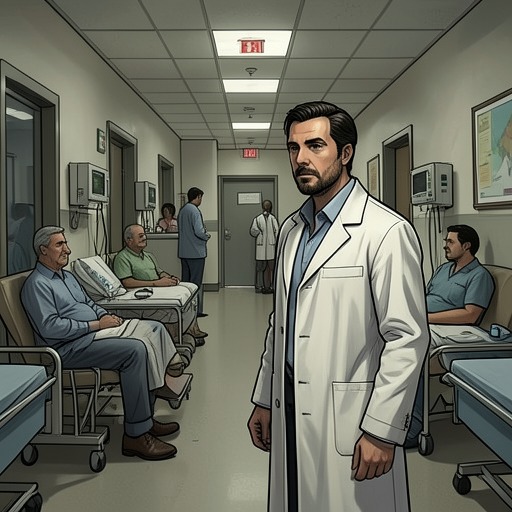
East of the MountainsAngel’s medical emergency becomes a test of whether Ben Givens can still act as a physician when he has set out expecting to die. On a Greyhound journey, Ben encounters a young fruit picker whose worsening illness has become an immediate crisis. He recognizes the danger, but care is complicated by the group’s fear of immigration scrutiny and the cost of hospital treatment. The episode turns Ben’s medical judgment into practical action: he calls for help, argues over access and payment, and stays until an ambulance takes Angel and his brother away.
The crisis on the bus
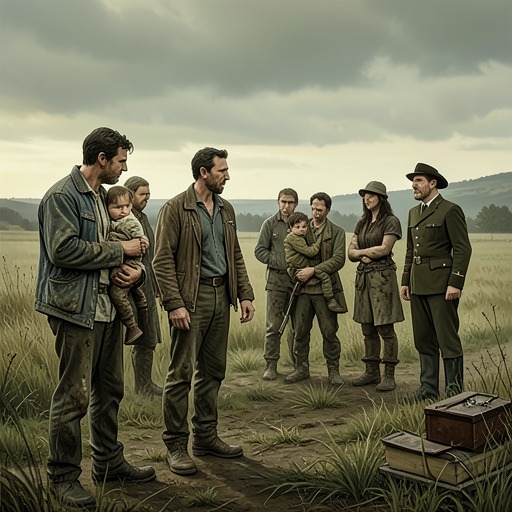
Angel is traveling with other fruit pickers when his illness intensifies. Catherine Donnelly introduces Ben as a doctor who wants to help. Ben cannot examine Angel properly or offer treatment: he is traveling without medical equipment, not even a stethoscope. From the reported symptoms, he considers tuberculosis and pneumonia, while recognizing that viral, fungal, or bacterial infections could also be responsible. His uncertainty does not make the situation less urgent; he tells the group that Angel needs a clinic or hospital as soon as they reach Wenatchee.
The practical obstacle is not simply the distance to medical care. Catherine warns that hospital staff may ask for identification or immigration papers and that Angel could be expelled from the country. The pickers also have little confidence that help exists outside the system they fear. When Angel suffers a severe coughing fit and brings up blood, the question of whether to seek treatment becomes immediate. His brother tries to comfort him, while Catherine and Ben confront the danger of delay against the risks the group associates with entering a hospital.
Calling for emergency care
After the passengers leave the bus, Ben decides to call 911 rather than allow the emergency to pass with the journey continuing. At the bus station at First and Chelan, he identifies himself to the operator as a thoracic surgeon and describes Angel’s blood-producing cough as an emergency requiring immediate assistance. He answers the operator’s questions about his identity, credentials, the symptoms, and the journey from Quincy. An ambulance arrives within minutes, and Ben directs the technicians to Angel, explaining his suspicion of tuberculosis and the need for an immediate medical workup.
Catherine serves as an intermediary with the frightened group. Angel’s brother does not want Angel taken away and feels responsible for him; the financial question reinforces his resistance. Ben tells Catherine to reassure them that treatment will not cost them anything, but Coleman, one of the emergency technicians, disputes that assurance. Odle counters that the hospital may be able to seek welfare assistance through the Emergency Medical Office. The disagreement makes plain that a medical emergency is also a dispute over what the system will provide and who can safely rely on it. Ben insists that treatment matters more than the argument over payment, while the technicians begin assessing Angel and prepare to transport him.
Separation at the station
The ambulance crew takes Angel’s temperature and checks his blood pressure and pulse as the station’s passengers watch. Catherine, who is due to continue west toward Seattle, asks whether Angel is likely to recover. Ben answers conditionally: he should improve with antibiotics if the suspected diagnosis is right. The answer conveys guarded hope, not certainty; the scene does not establish Angel’s eventual diagnosis or recovery.
Angel’s brother gets into the ambulance with him, but Coleman refuses to take the other young picker. He says there is no legal place for him to ride and that the hospital is within walking distance. The ambulance leaves with Angel and his brother, while the third boy remains in the loading bay with his bags. Catherine has already boarded the westbound bus, which departs without Ben. The emergency thus produces a concrete intervention but does not resolve the wider vulnerability of the traveling group: one sick worker is carried toward care, his companion goes with him, and another picker is left behind.
Ben’s return to medical action
For Ben, the episode is striking against the purpose of his journey. He had intended to be dead in the sage country, yet he now gives his professional assessment, calls emergency services, and advocates for a stranger. Earlier, while helping a veterinarian treat Rex, he had felt the unexpected pull of assisting with surgery after nineteen months away from operating on a human heart. The Angel episode extends that contrast: Ben has no equipment and cannot provide treatment himself, but he can recognize danger, communicate it clearly, and persist in getting help to someone whose circumstances make asking for it difficult.
His conduct does not remove the institutional barriers. He initially promises that care will cost nothing, only to have that assurance challenged; the technicians disagree about available assistance, and the concern about papers remains part of the decision. What Ben can do is refuse to let those uncertainties eclipse the immediate medical risk. The event therefore marks neither a cure nor a resolution, but a change in the direction of his attention: in the midst of a plan to end his own life, he assumes responsibility for another person’s chance to receive care.